
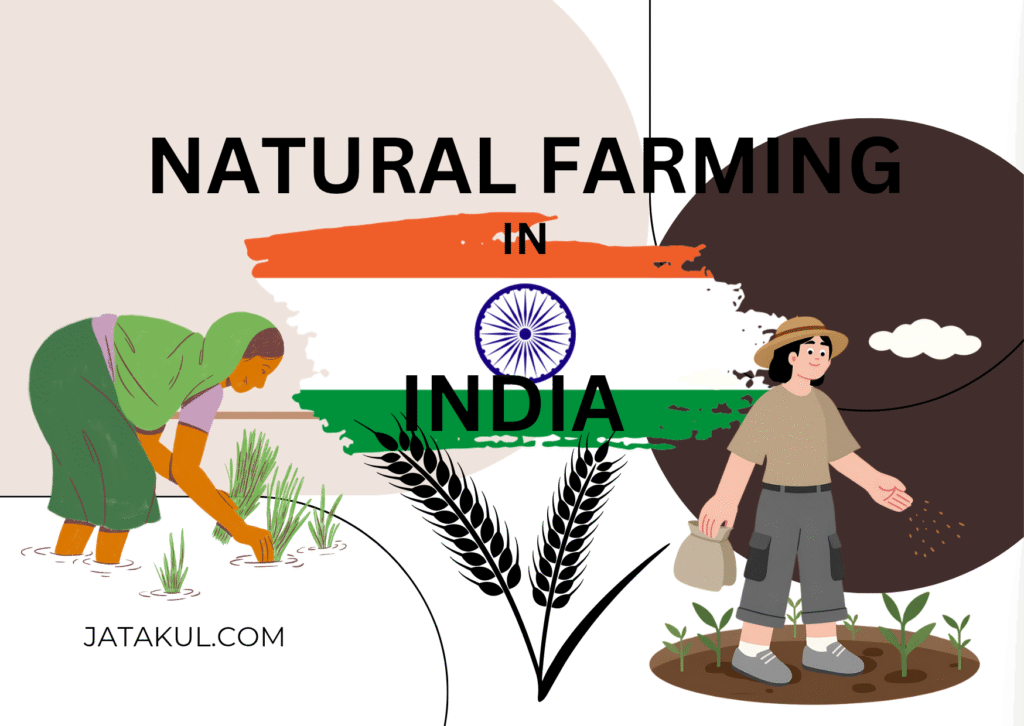
Natural farming has become an incredibly powerful moment in India. The main philosophy of natural farming is back to nature which gives the soil healthy without synthetic inputs. As soil degradation from chemical fertilizers, pesticides, and high-input farming increases, farmers are adopting sustainable and eco-friendly farming methods. This approach is not only eco-friendly, but also cost-effective and beneficial in the long run.
What is natural farming?
Natural farming is a farming method that uses absolutely no chemical inputs. It uses no fertilizers, no pesticides, and no hybrid GM (Genetically Modified) seeds. Farmers use only essential materials that are readily available around them—such as cow dung, cow urine, compost, mulching, Jeevamrut, and Beejamrut.
- Gobar(Cow Dung): Increases Soil fertility & Microbes
- Gomutra(Cow Urine): Natural Pesticides & Growth Booster for crops
- Compost: Agricultural waste best for long-term organic nutrients
- Mulching: Protect soil from direct contact of sunlight for Moisture retention and weed control
- Jeevamrut (Liquid Biofertilizer): A liquid solution that explosively increases microbial activity in the soil
- Beejamrut (Seed treatment): Beejamrut is a protection tonic that is used to coat the seeds before sowing.
Why Natural Farming is Growing in India?
India is an agriculture-based country where millions of farmers struggle with the high cost of chemical farming. The cost of fertilizer, seeds, and pesticides has made farming difficult for small farmers. Natural farming is the best alternative and cost effective for marginal and small farmer.
There is some major features that attracts Indian farmers towards natural farming:
- Zero or Very Low cost farming: The biggest Expenses in chemical farming are fertilizer, pesticides, hybrid seeds and growth ingredients. Farmers are compel to purchase this inputs from market in every crop session, which unnecessarily increases their investment, Whereas Natural farming significantly reduce its financial burden because the necessary inputs are readily available in the village or at homes, Like cow dung, cow urine, mulching, compost, jeevamrith and Beej amrit are easily available, eliminating the need to depend on market. Today’s high market cost is creating difficulties in small and marginal farmers. This is why natural farming is so beneficial for small and marginal farmers that requires less inputs and more outputs.
- Stable and Sustainable Yeilds: Chemical farming certainly increases yields in the short term, but in the long run, soil fertility decreases, pests resistant increases, and water requirements increase. Chemicals fertilizers kill soil microbes, reducing the soils production capacity over time. In contrast, natural farming give soil to regenerates because it contains more organic matter and uses no chemicals. In this healthy soil environment, crops grow without stress, water resistance increases, and pest infestations in the fields naturally decrease. The full impact of natural farming becomes evident after 2-3 years – crop yields stabilize, fertility improves, and farming becomes both sustainable and profitable in the long run.
- Better Soil Fertility & Healthy Ecosystem: The primary focus of natural farming is keeping the soil alive, as healthy soil is the foundation for healthy crops. In this system, soil is considered a living ecosystem, where soil fertility is naturally improved by increasing biological activity. When earthworms, microbes, and organic carbon increase in the soil, the soil produces nutrients on its own and continuously supplies them to plants—without relying on external fertilizers. Earthworms aerate the soil, microbes convert organic matter into nutrients, mycorrhizae increase nutrient absorption by plant roots, and organic carbon stabilizes soil structure. Together, these factors rebuild the soil, restart the nutrient cycle, and restore the soil to a natural balance, maintaining long-term productivity.
- Higher Profits Due to Low Investment: Natural farming earns higher profits for farmers because the investment is very Low and the Revenue earn is comparatively higher. According to the farming formula, profit = income – cost, and in natural farming, the cost is almost zero, so the net profit automatically increases. Whereas in chemical farming, a farmer spends approximately 30,000-40,000 rupees per acre, and in natural farming this expenditure is reduced to only 5,000-8,000 rupees. Furthermore, natural products are chemical-free, which is good for health for that their demand in the market is rapidly increasing and they also command an organic premium price. This combination of lower inputs and higher selling value can double farming profits, which is especially beneficial for small and marginal farmers.
- Government Support: The Government of India has launched several initiatives to promote natural farming, including dedicated programs like the Bharatiya Prakritik Krishi Paddhati (BPKP), the Paramparagat Krishi Vikas Yojana (PKVY), and the Subhash Palekar Natural Farming (SPNF), which provide farmers with training, awareness, demonstration projects, and support in adopting organic methods. The government operates training centers, workshops, and field schools in various states to provide farmers with practical knowledge of natural farming and facilitate its adoption. Financial assistance upto Rs.50,000/- per hector with attractive subsidy is also provided for organic inputs and bio-solutions. States like Andhra Pradesh, Himachal Pradesh, Karnataka, and Gujarat are rapidly implementing natural farming and encouraging millions of farmers to adopt this eco-friendly, low-cost, and sustainable farming model, leading to rapid growth of natural farming across the country.
- Future Outlooks: In today’s generations health awareness is increasing day by day. People are more concerning about their health for which demand for organic and chemical-free food is increasing, which motivates farmers to grow naturally and increase their income opportunity. Therefore, natural farming has become not only good for the environment but also vital for economic growth and rural empowerment.
Conclusion:
Natural farming in India is emerging as a powerful, eco-friendly, and cost-effective solution, as chemical farming has significantly burden financially, harmed soil health, water, and the environment, with long-term consequences for farmers. Natural farming restores soil fertility, activates microbial life, and stabilizes crop productivity without significant investment, naturally increasing farmers’ profits. In today’s times, where climate change, water scarcity, and input cost pressures are posing challenges to agriculture, natural farming can prove to be a strong foundation for a sustainable future. If every farmer in India adopts this slow and steady model, the country can build a long-term and secure future for healthy food production, a safe environment, and a cost-effective farming system.
PwtlEuluFMVvaRolifm