
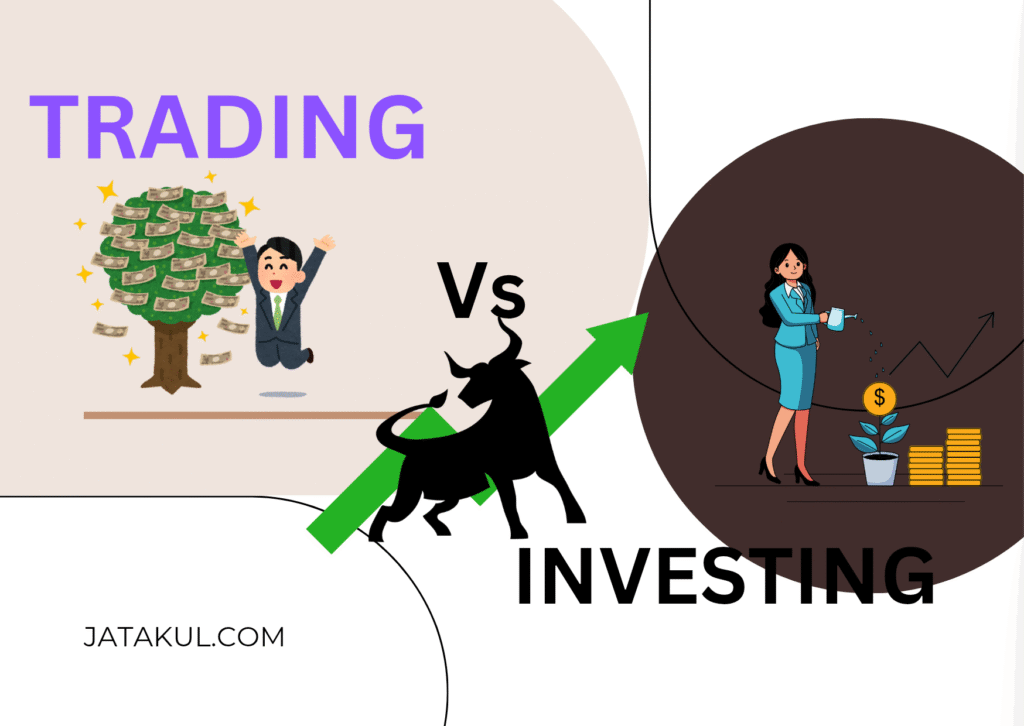
Trading and Investing are two popular ways to earn money in the stock market—1.Trading and 2. Investing. Comparing Trading vs Investing is a different journey stock market. Both aims to generate profits, but their time horizons, strategies, risk levels, mindsets, and approaches differ significantly from each other. If you’re new to the stock market, it’s important to understand the difference between trading and investing before jump into the Market. This will help you choose the right path based on your goals, risk tolerance, and financial plan.
In this article, we will deep into details of trading, and how it differs from investing, which one is better for beginners, and which approach you should take to maximize your profit.
What is trading?
Trading involves short-term buying and selling of shares/stocks to make quick profits. Traders tries to make profit on small fluctuations in market prices of stock/Shares.This period can range from a few seconds to days or weeks.The trading can be done in both indices and Stocks/Shares. To success in trading depends mainly on traders mindset,Quick decision, dynamic Strategy, and deep knowledge in technical chart.
Some popular trading styles:
- Intraday Trading: You can buy and sell a Stock in same day and you can put buy and sell orders numbers of time in market hours. Intraday Trading is a High Risk and High Return Strategy. It requires first decision making and some technical knowledge in chart reading and Market Trends.
- Swing Trading: Swing Trading is a type of trading where you can hold your order up to 2-10 days or even more. Here you have to go with the market trends. Before market will reverse you have to sell your order. It requires some Fundamental and Technical knowledge to predict market trends.
- Scalping: In this trading techniques, where a trader plots an order for a second orminutes. Traders books tiny profits from a single-single trade. This trade depends mainly on price fluctuations of stocks or indices.
- Positional Trading: In this trading techniques, position can be hold for a week or month. This trade is based on short term trends of market.
What is Investing?
The word investing has a very broad meaning, but stock market investing is nothing but buying a Stock on the basis of her fundamentals, like company performance, results, and you have to look into various aspect of the company. The primary objective of investing is long-term wealth creation. Investors hold a stocks for months, years, or even decades. In investing, patience is the most important factor in this approach.
In investing your mindset should be discipline, long term vision, and slow but steady approach.
Key Points in Investing:
- Capital Appreciation: Capital appreciation means that the value of your investment increases over time. For example, if you bought a stock for ₹2000 and its value increased to ₹2,500, the ₹500 increase over time is capital appreciation. This is the most natural and powerful way to build long-term wealth.
- Dividend Income: Dividend income is the regular income that companies pay out quarterly/yearly to their shareholders as share of profits. If you hold shares of dividend-paying companies, you receive additional income without having to sell the shares. This creates a strong source of passive income.
- Compounding Return: Compounding returns is called the “magic” of finance. Simply, it means earning a return on your returns. If you don’t withdraw your profits and keep reinvesting, your wealth grows exponentially over time. The longer the time period you hold, the more powerful the compounding returns will be generated.
- Long term Financial Freedom: Long-term financial independence means having enough money to live comfortably without a job or business. It’s achieved through sound investments, regular savings, compounding returns, and long-term planning. Financial independence provides a stress-free life and the freedom to make decisions.
In the journey of investing most successful investor are mainly focuses on Company Fundamentals, Balance sheet, Profit growth, and Competitive advance or moat of company and long term trend of an Industry.
What are the Key Differences in Trading vs Investing?
| TRADING | INVESTING |
| Short term capital gain, trading can be done for second, minutes hours or day. | Investing is a long term capital gain, trade can be hold for a month, year, or decade |
| Risk in trading is very high, Trading requires market volatilities, Stop Loss is most for trading, frequent trade for tiny profits | There is moderate to low risk in investing, long term holding reduces market fluctuations, compounding effects wealth creation. |
| More technical analysis is required Ex: candle stick patterns, indicators (RSI,MACD,EMA), Support & Resistance. | Mainly fundamental analysis is needed EX: Companies Earnings, Management Quality, PE Ratio, ROE, Profits, Debt level, Leadership Quality etc. |
| Main Objective of trading is Quick Profit, Frequent Gains, and focus on price movements. | Main objective of Investing is Long term wealth creation, Long term Portfolio growth, Financial Freedom. |
| In trading very high technical skill is required like first decision making, risk control, chart reading, and emotion management is very crucial in trading. | Very less technical skill is required, patience, research ability, long term vision and calm during market volatilities is required. |
| High Return and High Risk in trading | Slow but steady return and long term capital gain is appreciated |
Which is better- trading or Investing?
- Trading requires less capital or can be trade with leverage amount given by different brokerage house and best suited for those who are interested in charts and technical analysis, are willing to take risks, seek quick profits, can actively monitor the market, and adhere to strict stop-loss discipline.
- Investing, on the other hand, is requires large capital there is no leverage for long term holding of stocks, hence, an excellent choice for those who want to build long-term wealth, seek steady and predictable growth, are patient, can remain calm during market fluctuations, and enjoy in-depth analysis of company fundamentals.
- Trading is fast-paced and high-risk, while investing is slow, steady, and the safest path to long-term growth—and choosing between the two depends on your personality, goals, and risk tolerance.
Why beginners should prefer investing?
- Investing is best for beginners because it involves relatively low risk and offers long-term benefits. In investing beginner can first learn the market fluctuation where as in trading is very fast and quick action instrument.
- Investing also offers the powerful advantage of compound interest, where your money grows automatically over time. Furthermore, investors don’t need to monitor the market daily, which reduces emotional stress and leads to more stable decision-making. Long-term investments also make it easier to predict growth because you invest in strong companies and assets based on fundamentals.
- If you’re new to the stock market, always start with investing and only begin trading after gaining proper knowledge, risk management, and solid experience in chart reading.
Conclusion:
Trading and investing are both effective ways to make money in the stock market. Trading is for short-term gains, where risk is higher and execution is faster. Investing is for long-term growth, where risk is lower and your wealth multiplies through compound interest.If you want stable, stress-free, and long-term wealth, investing is the best option. If you like rapid market changes and risk-taking, you can try trading—but only with proper knowledge.
If you ask for our recommendation then we will prefer the best approach for beginner is start with investing, learn slowly, and then experience trading with a small capital.
eWSRuiCFNZkpKfmV